(K Vishvdev Rao) (Lucknow)
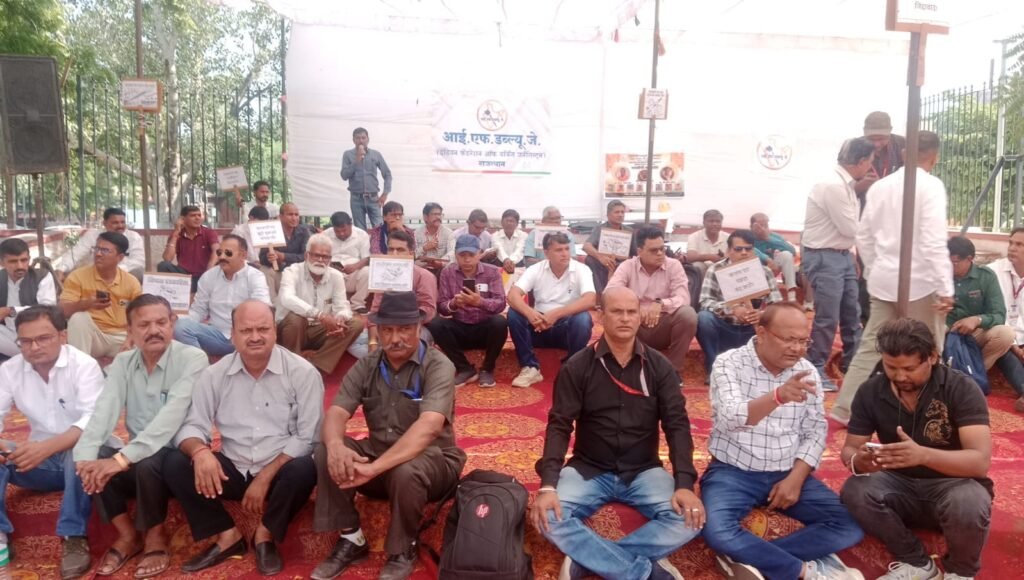
• IFWJ’s national appeal: A Central Journalist Protection Act to address threats, assaults and harassment against working journalists.
• National pension framework: IFWJ seeks a Central-sponsored scheme for accredited and working journalists across India.
• Gujarat’s ₹100-crore proposal: GJU proposes a dedicated Pension and Welfare Fund backed by government, journalist and employer contributions.
• ₹30,000 monthly pension: GJU seeks inflation-linked support for eligible journalists with at least 20 years of professional service or experience.
• Beyond retirement benefits: Family pension, healthcare, education assistance, disability support and emergency relief form part of the proposed safety net.
• Recognition in a changing media landscape:GJU seeks fair accreditation for veteran independent journalists and equitable government-advertisement opportunities for eligible digital platforms and small newspapers.Can a democracy that depends on journalists to question power, expose wrongdoing and speak for citizens allow the very people who perform this public duty to face financial insecurity in old age? And should a journalist’s access to social security depend on the state in which the person works—or whether the person remains on a media organisation’s payroll?These questions are at the heart of a significant welfare appeal made on the 76th Foundation Day of the Indian Federation of Working Journalists (IFWJ), which has sought a national pension scheme and a Central Journalist Protection Act from Prime Minister Narendra Modi. In Gujarat, the Gujarat Journalists’ Union (GJU) has placed a more detailed proposal before Chief Minister Bhupendrabhai Patel: a ₹100-crore initial corpus, an inflation-linked monthly pension of ₹30,000 and a continuing funding mechanism to protect journalists and their families.Together, the demands raise a compelling policy question: is it time for India to move towards “One Nation, One Pension” for journalists?From national demand to state-level actionIn its memorandum dated October 28, the IFWJ has submitted a three-point charter to the Prime Minister: enact a Central Journalist Protection Act, establish a national pension scheme for accredited and working journalists, and create a national register to identify genuine media professionals and facilitate transparent delivery of welfare benefits.The federation argues that journalists face physical threats, harassment and assault while reporting from the ground, while many experienced professionals confront financial distress after decades of public service. It has pointed to Maharashtra and Chhattisgarh as states that have taken legislative steps on journalist protection, while calling for a more uniform national framework.The IFWJ also invokes the legacy of its former president, Dr K. Vikram Rao, who, it says, devoted his life to responsible journalism, press freedom and better financial security for journalists.Prime Minister Narendra Modi’s observation, quoted in the GJU memorandum, provides a wider democratic context: “An aware and well-informed society is fundamental for a healthy democracy. In this mission of strengthening democracy, the media plays a crucial role…”If an informed public is essential to democracy, the organisations argue, the people who help create that public awareness deserve meaningful social security.GJU’s blueprint: ₹100 crore to start, three-way funding to sustainGJU’s memorandum urges Gujarat to establish a dedicated Gujarat Journalists’ Pension and Welfare Fund, with an initial government corpus of ₹100 crore. To provide continuing financial support, it proposes three contributions: 5% of eligible state government media-advertising expenditure, 2% of participating journalists’ Basic Pay and a matching 2% employer contribution.The union seeks an inflation-linked pension of ₹30,000 a month for eligible journalists with at least 20 years of journalistic service or experience, including eligible district and mofussil correspondents. It also proposes family pension for surviving spouses and additional pension linked to advanced age.The proposed enhancements are 25% at 70, 50% at 80, 75% at 85 and 100% at 90, alongside appropriate inflation or dearness relief.GJU’s comparative study cites monthly journalist pension provisions of ₹25,000 in Arunachal Pradesh, ₹20,000 in Madhya Pradesh, Maharashtra and Chhattisgarh, and ₹18,000 in Rajasthan, among other state-level provisions. These figures are to be presented in the union’s memorandum and would require verification against the latest applicable government orders before being treated as current entitlements.Pension is only the beginningThe Gujarat proposal extends beyond retirement income. It envisages healthcare and critical-illness assistance, accident and disability support, death assistance, educational aid for eligible journalists’ children, emergency relief and, subject to policy and financial feasibility, housing-related assistance.GJU also proposes an independent, professionally managed and annually audited fund, with representation from government, journalists’ organisations and media employers. The objective is to protect the corpus, ensure transparent eligibility and prevent delays in processing applications.Importantly, the union says the scheme should not be restricted solely to journalists holding government accreditation. Eligibility, it argues, should recognise verifiable professional experience and service across print, electronic and eligible digital news media.The independent journalist cannot be left outThe GJU memorandum addresses another growing concern: experienced journalists who leave regular employment because of automation, restructuring or disputes over implementation of Majithia Wage Board recommendations, and subsequently establish their own digital platforms or small newspapers.The union seeks fair and equitable opportunities for such credible ventures to receive government advertisements under transparent, reasonable and uniform criteria. It also calls for a separate accreditation category for experienced independent and freelance journalists, alongside rationalisation of eligibility conditions for veteran journalists under Gujarat’s press accreditation rules.The argument is that journalism does not end when a professional leaves a newsroom’s payroll. Long service, editorial responsibility and continuing public-interest work should receive due consideration, subject to documentary verification and professional accountability.Will Gujarat turn a long-pending demand into policy?GJU’s memorandum recalls earlier representations and assurances, including directions to the Information Department to examine the pension demand. It argues that the time has come to move from repeated consideration to a defined implementation process.The union has also proposed naming the fund after Sardar Vallabhbhai Patel as a tribute marking his 150th birth anniversary.For the IFWJ, the immediate challenge is to secure a national framework for protection and pension. For GJU, the task is to persuade Gujarat to become a model for the rest of the country.The principle behind both appeals is straightforward: journalists may retire from active reporting, but their contribution to democracy does not retire with them.Whether the Centre and the states respond with a coordinated social-security framework will determine if “One Nation, One Pension” becomes more than a slogan—and whether the Fourth Estate receives the dignity and security its public service deserves.SEO KEYWORDS: One Nation One Pension for Journalists, IFWJ journalist pension demand, Gujarat Journalists Union, GJU pension scheme, ₹30,000 journalist pension, ₹100-crore journalists welfare fund, Central Journalist Protection Act, journalist welfare India, veteran journalists accreditation, freelance journalists, digital media government advertisements.o